April 30th, 2012
This out-take from the Atlantic’s Jonathan Blow piece is priceless.
3 commentsAvengers vs. X-Men
April 25th, 2012
Marvel has been pushing this year’s big event series, Avengers vs. X-Men, as hard as they’ve pushed anything since Civil War. Three issues in, it’s not surprising to report that the series is . . . underwhelming. Even by the standards of Event Comics. (Whoever thought we’d look back on Civil War as an example of reasonably well-executed, commercialized plot-shifting?)
I’m not totally shocked that the writing is stiff and bloated–the thing has five credited writers. But what really has surprised me about the A vs. X books is how embarrassingly sloppy the art is. This is Marvel’s long-gestating, summer mega project and the product that will be there to capitalize on an Avengers moviegoers who decide to try taking a dip into comics. And it features panels like this:
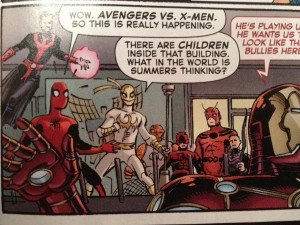
Check out Spidey’s neck there. Click to enlarge and really see how tossed-off those pencils are. Then there’s this:
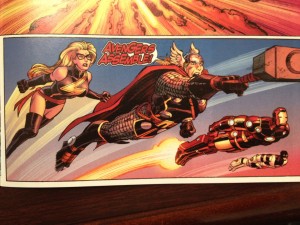
Thor’s face is like, what? And then there’s this Ms. Marvel:
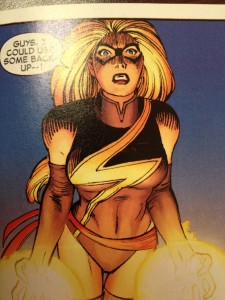
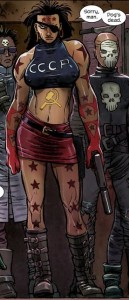
Who looks uncannily like Mother Russia, from Kick-Ass 2:
Look, I get that John Romita Jr. isn’t Alex Ross. He’s not doing hyper-realistic, beautiful oil-on-canvass for each panel. And Romita’s work can be wonderful in its own right. But the stuff in Avengers vs. X-Men looks like he was drawing with a Disney exec was standing behind him with a stopwatch and a meat cleaver.
1 commentJVL Elsewhere
April 23rd, 2012
Two pieces over the weekend. One, a review of Michael Sandel’s What Money Can’t Buy. (Where I’m a pinko squish. Again.) Second, a mid-size essay on the legal doctrine of “wrongful birth.” Which was basically the most depressing piece I’ve written in the last ten years. You’ve been warned.
7 commentsAmazon, the e-book, and the Melding of Monopoly with Monopsony
April 18th, 2012
A fantastically interesting piece, with an aspect of e-book buying I didn’t know before:
2 commentsIt is possible to unlock the DRM on a Kindle ebook and transcode it to epub format for use on other readers; but it’s non-trivial. (Not to mention being a breach of the Kindle terms and conditions of use. Because you don’t own an ebook; in their short-sighted eagerness to close loopholes the publishers tried to make ebooks more like software, where you merely buy a limited license to use the product, rather than actual ownership of an object.) So, because Amazon had shoved a subsidized Kindle reader or a free Kindle iPhone app into their hands, and they’d bought a handful of books using it, the majority of customers found themselves locked in to the platform they’d started out on. Want to move to another platform? That’s hard; you lose all the books you’ve already bought, because you can’t take them with you.
Apple TV
April 18th, 2012
Like everyone else, I’m waiting to see what Apple does in the TV space, but this bit of cold water, which predicts that an iTV isn’t going to happen, makes some cogent observations:
One reason is that TVs are an extremely competitive, commoditized market with very slim margins and most purchasing decisions going to whoever has the most features. You can draw some parallels to markets that Apple’s doing well in, like smartphones and computers, but Apple has chosen only to serve the high end of those markets. How big is the high end of the TV market? How many people are willing to spend a significant premium over the competition for a TV?
It causes practical problems, too: TVs usually require large warehouses and very large retail display areas, which Apple’s retail stores aren’t ideal for. And large TVs usually require in-home service, which Apple doesn’t offer for any other products. . . .
A bigger problem is that Apple prefers to offer fully integrated products, but a modern TV is just one component in a mess of electronics and service providers, most of which suck. Apple doesn’t want their beautiful, it-just-works TV to need to interact with Onkyo’s 7.1 HDMI-switching receiver, Sony’s 3D Blu-ray player, Microsoft’s game system, Comcast’s awful Scientific Atlanta HD DVR, Canon’s newest camcorder, the photos on your point-and-shoot’s SDHC card, and your Logitech universal remote. (The need for TVs to have a more complex remote than the Apple TV might be fatal alone.)
But the real kicker is this:
0 commentsBut the biggest problem that I suspect will keep Apple out of the TV business forever is much more basic:
How often do people buy new TVs?
Apple’s primary business is selling computing devices and related hardware, with healthy margins and tightly integrated experiences, to customers who generally replace them with the newest models every 1-3 years.
There’s no place for them in the TV market, and they’re content (and smart) to stay out of it.
Elevated Political Discourse
April 18th, 2012
If all political commentary was at the level of this Bill Galston – Ed Kilgore – Ramesh Ponnuru – Sean Trende debate, America would be a better place. It’s the kind of exchange that the New Media promised us back around 1998.
0 commentsHunger Games Barbie
April 16th, 2012
(I may, or may not, have pre-ordered one for the stone-cold killer in my life.)
3 commentsRobert Caro: On Writing
April 16th, 2012
Esquire has an amazing piece on Robert Caro by Chris Jones. Do not miss it.
I’m endlessly fascinated by the process of great writers, and Jones delivers the goods with Caro. Sample awesome:
After Caro composes his one or two anchor paragraphs, he writes his outline, the first of his outlines. This is the one that he pins onto his bulletin boards: maybe two dozen pages, typewritten on his Smith-Corona Electra 210. (“It’s like giving your fingers wings,” the advertisements in Life magazine read in 1967. “They just kiss the keys. Never punch them.” Caro has nine spares that he can cannibalize for parts, and he collects ribbon like a hoarder.) Here, he writes only the briefest sketches of scenes, entire chapters reduced to single lines: His Depression or The Cuban Missile Crisis. “Once that’s done,” Caro says, “I don’t change it.” He has his frame.
Then he writes a fuller outline that usually fills three or four notebooks, throwing himself into the filing cabinets that surround him, the yields from nearly four decades of research. Caro has spent vast stretches of his life poring over documents, mostly at the Johnson Library in Austin — it alone contains forty-five million pages, held in red and gray boxes, many of which he is the only visitor ever to have opened, rows and rows of boxes stretched across four floors — and interviewing hundreds of subjects. Some have stopped talking to him; he lost Lady Bird Johnson’s ear after the first book. . . .
Caro flew to Florida unannounced — “it’s harder to say no to a man’s face,” he says — and knocked on the door. Soon Caro found himself inside, filling notepads with scribbled secrets about Johnson’s cruel collegiate rise, then returned to his hotel to type up another transcript to slip into another file to slip into another drawer.
Each of the files is labeled in blood-red ink — Busby, Horace; Jenkins, Walter; The Gulf of Tonkin — and given a code. (A particular file on the assassination of John F. Kennedy is labeled ASS. 107X, for instance.) Caro’s outline contains hundreds of these codes, leading him directly to the file he will need when he is writing that particular section. “I try to have a mood or a rhythm for a chapter,” he says, “and I don’t want to interrupt it, searching through my files.” . . .
Only after he has filled and annotated those notebooks does Caro begin to write, three or four drafts in longhand, on pads of legal paper. With each pass, muscle is added to the frame. Finally, Caro feels prepared to give his fingers wings. “There just comes a point you feel it’s time to go to the typewriter,” he says. He does write quickly; the math dictates that he must. When he finished The Power Broker, it was thirty-three hundred typewritten pages, more than one million words. (Gottlieb cut three hundred thousand: three normal-size books.) Caro’s sentences are long, fluid, intricate. (A single sentence inThe Passage of Power contains a parenthetical, an em dash, a colon, a comma, another two commas, a semicolon, two more commas, and a period.) There are stretches in each of his books that feel as though they rolled out of him in flurries, and they feel that way because they did. Three or four more drafts will appear out of that battered Smith-Corona Electra 210, each one hundreds of thousands of words, until he has his final draft.
There’s much, much more. Print it out and treat yourself.
6 comments