July 16th, 2012
Last Friday’s revelation that Mitt Romney was technically (or, “technically”) still CEO of Bain Capital from February 1999 to 2002 probably doesn’t mean much. In the grand scheme of things, the fact that Romney was still listed as being CEO and still signing corporate documents will probably fade in the face of the reality that he was professionally checked out from the gig and not doing much more beyond figurehead duties.
That said, the incident does provide another couple datapoints about Romney.
First, why is February 1999 the line in the sand? Is Romney suggesting that everything Bain did pre-2/99 was hunky-dory but that some of the stuff that came after it might have been problematic? If Bain is an admirable outfit and nothing that it did should give voters pause, then what does it matter to Romney? Shouldn’t he be willing to own everything that the company did even when he was only “technically” the CEO?
More importantly, the manner of Romney’s departure from Bain reminds me of how he got started with the company. Romney had the sweetest deal ever for a risk-taking entrepreneur: The idea for the business was not his. The money for the start-up was not his. If the start-up failed, he was promised that he could have his old job back, at an increased salary. And he was explicitly promised that if the start-up failed, his old company would make up a public excuse absolving him from personal failure. This isn’t a criticism–Romney succeeded and his company did great. It’s just worth remembering that even by the standards of successful millionaire entrepreneurs, Romney’s life has been highly atypical. He managed to wind up in a situation where whether he failed or succeeded, he’d do very, very well for himself.
(If I were cutting ads for Obama, I’d argue that this was synecdoche for the entire Bain business.)
In any event, here Romney is in February 1999 and he’s off to save the Olympics and maybe use that to springboard into politics and it’s a dicey proposition. And yet, Romney’s not working without a net. Because he’s still “technically” CEO of Bain Capital and if things don’t work out . . . well, he’ll be okay.
I don’t mean to make too much of this–at that stage in his career (or any stage, really), Romney was going to be okay no matter what. He was connected and wealthy and didn’t need a CEO fig-leaf to provide him with financial/professional security. But I do wonder what this says about Romney’s inherent approach to risk and how that would translate to the presidency.
Bonus Romney: In defending his decision not to release more of his tax returns, Romney decided to go with this approach:
He said his own campaign was happy to compare itself with Obama’s administration on transparency, citing president’s use of executive privilege to withhold documents related to the botched Fast and Furious program.
Wait–so unless I’m translating this wrong, Romney says he isn’t going to release his tax returns because Obama hasn’t released Fast and Furious documents. And two wrongs make a right. Or something.
7 comments
George Lopez. Mitt Romney. Identity Politics.
July 15th, 2012
George Lopez clearly doesn’t know much about politics in general, or Mitt Romney in particular. Last night he joked (?) that Mitt Romney “ain’t going to get” the Latino vote because he’s “a f–king Latino and he won’t admit it.”
If Romney could credibly claim some significant portion of Mexican heritage for himself, he’d never shut up about it. And the same goes for every other single politician working in America right now. Pols in both parties are dying to cut into the Hispanic vote and catch it before it aligns semi-permananently and, so far, about the only appeal any of them have figured out is identity politics.
What world is Lopez living in where he thinks on-the-make politicians go out of their way to shun identity politics?
4 commentsMy Gift to You
July 13th, 2012
Galley Friend Mike Russell with a wonderful comics-essay on superhero movie. Not to be missed.
0 comments“Overpopulation” and Population Density
July 13th, 2012
When I write about demographics and the problems with the world’s collapsing fertility rate the first bit of pushback I get is always the same: But the world is overcrowded already! We don’t need more people!
The second part of this argument is complicated but the first is not. The world only looks overcrowded if you live in a major metropolitan area. America, for instance, may look overcrowded if you live in New York or Los Angeles, but the view from Montana is quite different. Yesterday Galley Friends B.W. and K.S. sent me this wonderful graphic on how much space it would require to fit the entire world’s population in one place, using the densities of some pretty livable, modern cities. (Click to enlarge.)
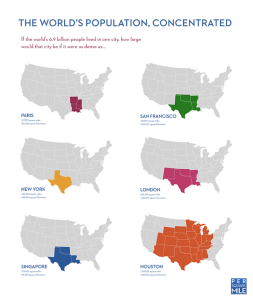
There’s no real point to this–it’s a rhetorical exercise. But it highlights pretty nicely how uncrowded the world is. There are other arguments against population growth, but overcrowding isn’t one of them.
13 commentsThe Danger of Overnight Delivery
July 12th, 2012
I wasn’t entirely surprised to read Farhad Manjoo’s interesting piece about Amazon moving from two-day and overnight shipping to overnight and same-day. (A military friend of mine who specializes in high-level logistics planning was just hired by the company to work on standing up new shipping centers. I figured they wouldn’t have poached him if they were only going to be building one or two new shipping centers.)
But I do wonder if Amazon also risks getting boxed in by UPS. Because if they move to overnight and same-day shipping, they become completely beholden to a single vendor. Which is never a good thing, even if you’re the world’s second largest monopsonist.
As things stand now, Amazon has a theoretical alternative to UPS. They could, if push came to shove, threaten to go with the USPS to make their deliveries. It wouldn’t be smooth. It would cost too much. But in the even that Amazon hit an impasse with UPS over contract renewal, they could use the Post Office as a stop-gap until they brought Fed-Ex online as their primary shipper. (Of course, at that point Fed-Ex would have enormous negotiating power and Amazon would likely get screwed in any deal.)
But once Amazon goes to overnight and same-day delivery, there is no stop-gap. Fed Ex is the only operation who could fill the role and they couldn’t do so overnight. UPS will have the power to effectively shut down Amazon.
Would it hurt UPS to lose what is probably its biggest client? Absolutely. But UPS has lots of other clients. Their profit stream may (or may not) depend on Amazon, but the UPS machine wouldn’t grind to a halt without them. Amazon’s entire business would.
And if you’re UPS and you see that Amazon is making a killing and putting all of its brick-and-mortar competition out of business, then you should probably conclude that, since you’re the indispensable intermediary, you’re not charging them enough.
7 commentsRepublican Presidents and Conservative SCOTUS Judges–Updated
July 11th, 2012
With all respect to Clint Bolick, his WSJ piece yesterday seems conflicted at the end. In his close, Bolick writes,
[T]he science of nominating philosophically consistent justices has grown more precise. In the past, presidents from Abraham Lincoln to Franklin Roosevelt to Richard Nixon tried to pack the court with reliable fellow-thinkers, with decidedly mixed success. Dwight Eisenhower famously remarked that his two biggest mistakes both served on the Supreme Court (Earl Warren and William Brennan). John F. Kennedy appointed Byron White, who turned conservative toward the end of his tenure, and George H.W. Bush appointed David Souter, who was liberal from day one.
These days, however, justices are carefully chosen on the basis of long philosophical track records. Indeed, most Supreme Court justices today remain more true to their principles than the presidents who appoint them
A Republican president may spend like a drunken sailor or destroy capitalism in order to save it, and a Democrat may bail out Wall Street and fail to bring the troops home. But they will never disappoint their respective bases on Supreme Court nominations.
I’m not sure I’m convinced of this argument. In last week’s Newsletter, I did a quick count:
In the last 43 years, Democratic presidents have appointed only 4 justices (Kagan, Sotomayor, Breyer, and Ginsburg). They’ve all been reliably liberal, especially in important cases. Republican presidents, on the other hand, have made 12 appointments. Of them, a not insubstantial number were, to put it delicately, not reliably conservative. Blackmun, Stevens, and Souter were largely liberal. Powell and O’Connor were decidedly moderate. It wouldn’t be fair to lump Roberts in with either of these groups (not yet, anyway) (I kid!), but taking him out of the mix means that barely half of the Republican-appointed justices vote the ideological “party line” while all of the Democratic-appointed justices do.
If you go back another administration, Johnson appointed the reliably liberal Thurgood Marshall. (His other appointment, Abe Fortas, wasn’t with the Court long enough to really count for our purposes.) In fact, to find a Democratic-appointed justice who departed from party orthodoxy, you have to go all the way back to 1962 when JFK put Whizzer White on the Court.
Maybe the science has progressed over the last 40 years, but the case of John Roberts suggests that it hasn’t. Or at least not all that much. (Or perhaps, it has progressed for Democrats but not for Republicans.)
An interesting side question is whether or not Harriet Miers would have flipped and gone along with Roberts had she been on the court. It’s impossible to know, of course. But if, theoretically, she had then it would mean that W. would have gone 0-for-2. Or maybe, (0.5 + 0.5) for 2.
Does anyone really think that Mitt Romney would nominate more conservative SCOTUS justices than W. did? As Ben Domenech likes to say, the next pro-life judge Romney appoints will be his first.
Yes, yes, Obama would certainly nominate more liberal judges than Romney. But my point is that a Romney presidency doesn’t guarantee that we get conservative justices any more than the Reagan or Bush presidencies did. And probably a good deal less. The choice isn’t between getting liberal justices or conservative justices. It’s between getting liberal justices and (at best) an even-money chance at a conservative justice.
Update: Galley Friend M.F. writes in with some persuasive disagreement:
1 commentI, too, found the end of Bolick’s piece . . . incongruous, but a few friendly quibbles with your analysis.
(1) It’s very hard to compare GOP appointments and Dem appointments historically as modern “legal conservatism” as we know it really didn’t come about until after Roe v. Wade. So, for example, take Nixon.
Rehnquist was really the only one of his justices we would call a “conservative” in the true sense–and it bears noting that lots of legal conservatives never cared for him as he was a right-wing judge whose time on the Court predated and thus was not governed by “originalism” or any other consistent conservative methodology.* And yet when Nixon was putting people on the Court he was trying to correct Warren, Brennan, and Douglas on criminal procedure, antitrust, and busing.
I can’t speak reliably to busing, but as a rule Burger, Rehnquist, Powell, and Blackmun were pretty good (at least for a while) in letting Harry Callaghan off his leash and quite good in correcting course on antitrust (although that wouldn’t really come around until Bork, Posner, and Easterbrook changed all the terms of the discussion in the ’80s). O’Connor was pretty good by these standards, too. The trouble is Roe changed that as the litmus test. But even there, as Robby George likes to point out (and the language of Roe confirms it), square Republican Harry Blackmun thought he was writing a conservative decision–it was about professional prerogatives for physicians as written by the former GC of Mayo. (And his judicial “evolution” coincides interestingly with his post-Roe conversion from lame Republican Harry to the eminent Justice Blackmun, Jurisprude and Defender of Women.)
It took a little while to figure out how wrong Roe-like reasoning was, and that process happened to coincide with the ascendance of Scalia, Bork, Berger and the development of an authentically conservative farm team (under the leadership of Ed Meese or so seems to be the consensus) and the Federalist Society. So it wasn’t until the late 80s that you had any sort of institutionalized actual conservatism on the circuit courts from which to find SCOTUS picks. So while Reagan had to go to the Arizona Court of Appeals in 1981, any appointments between 1985 and 1992 had their picks of Scalia, Bork, D. Ginsburg, Starr, Santelle, Silberman, O’Scannlain, Scirica, Luttig, Wilkinson, Garza, Jones, Edmundson, etc. Reagan seems to have realized this since he only got to Kennedy after Bork and Ginsburg went down, and even Souter almost lost to Jones, which would have made things very different. It’s an imperfect but relatively young process that’s been getting better over time.
(2) Very droll by Ben Domenech, but I’ve never been sure why Romney appointing pro-aborts to the Massachusetts Court of Cow Probate for the West Southwestern Central Judicial and Gaming District mattered. He never got to nominate someone to the SJC and since most of the MassResistence/Jason Jones stuff involves non-policy-making courts (e.g. criminal trial courts) I have to assume he never nominated a pro-abort to a court that could develop questions of law because if he did, his pro-life Catholic opponents surely would have made everyone aware of it.
(3) While the choice is between certain regression with Obama and possible progress with Romney, I think that still understates things at the Supreme Court level. The simple fact is that it’s a closed universe. There is a finite number of papabile lawyers out there, almost all of whom are federal circuit judges, appointed by a Republican and under 55 (plus about five others). One can come up with a 90%+ complete list in 5 minutes. The beauty of the Bush years was not just that they got Roberts and Alito on the Court (whatever one thinks of the former now), but that the White House Counsel’s Office was sure to put in an excellent college of cardinals for next time.
No Romney critic I’ve talked to has been able to name any plausible bad nominees, let alone any plausible bad nominees that are worse than the best we would hope for from Obama (e.g. Denny Chin). The danger is the AAA team that will be set up for next time on the circuits by Romney, which needs to have a lot more women and minorities on it. Looking at who’s on Romney’s judicial advisory list I’m confident they’ll find the right people from underrepresented groups for that if they’re the ones staffing the White House. If it’s Boston Mafia, I’m somewhat less confident.
*Here, actually, is an underemarked comparison to Chief Justice Roberts. Rehnquist was famously hostile to Miranda, and when the opportunity finally came potentially to overturn it in 2000’s Dickerson v. U.S. he went with the liberals and wrote the opinion in such a way as to (a) make a constitutional hash of Miranda (it’s now a “constitutional rule” but not in the Constitution) and (b) make it as close to useless as he possibly could. People say Roberts was looking to Marbury with NFIB; I think he was looking to his old boss. Of course, Rehnquist would have struck down Obamacare root and branch, so . . .
In Defense of Tom Junod. Sort of.
July 10th, 2012
For my money Tom Junod is one of the ten best essayists working in America these days. I’ll put his stuff up there on the high shelf with Andy Ferguson and Matt Labash and David Grann and Joan Didion. Don’t believe me? Go sit with his profile of Jon Stewart, his piece on Fred Rogers, his essay on the horror of 9/11–and these aren’t even his sizzle reel. I can’t find links to his opus on Lil’ Bow Wow and a piece on porn valley from the late ’90s that blows me away every time I read it.
All of which is why Junod’s 2008 piece on the Obama-McCain race was kind of heartbreaking. It’s not that Junod is a liberal and a Democrat and an Obama voter–more than half my friends and family checked those three boxes. It’s that it revealed that Junod’s approach to politics and politicians was . . . well, let’s just say the piece was embarrassing and not his finest hour and leave it at that.
So today Junod has a giant piece out about the President Obama’s killing of al-Alwaki’s kid. And Ed Driscoll drills down to the heart of the problem Junod faces: That Junod has become what he explicitly warned about in 2004. It’s a pretty tough assessment by Driscoll; but also pretty fair.
But that’s nothing like what Moe Lane does to Junod. His excoriation is just flat out brutal. And again, pretty fair.
The bigger question posed by Moe Lane’s vivisection is why more liberals haven’t turned away from Obama. There’s a small cadre of liberals, like Glenn Greenwald and Junod, who have criticized Obama on principle. And that’s great–God bless ’em. But you don’t see–or at least I haven’t seen–liberals publicly turning their backs on Obama and jumping ship. And I wonder why that is. There were plenty of Republican types whom Bush drove out of the party. (Andrew Sullivan, Kathleen Parker, Andy Bacevich, Jim Webb, etc.–the list is actually pretty long.) Why haven’t any lefty Dems done the same? As Lane points out, if you’re a liberal and you fell a-over-t for Obama and now you realize that he’s elevated cold-blooded murder to the level of routine executive prerogative, why haven’t you clapped your hands together, stepped away from the table, and said, “I’m out”?
Update: Moe Lane has a couple of theories here. What he’s getting at, I think, is that liberals are more partisan (by which I mean, more wedded to the Democratic party) than conservatives. That’s certainly possible. His alt-theory is that liberals are more repulsed by Republicans than conservatives are by Democrats–and so find the prospect of flipping, even temporarily, less acceptable.
A third theory might be that liberals have the Nader-Gore 2000 debacle still fresh in their minds and so basically subscribe to the Natasha Romanov school of political theory: That love is for children.
The only problem with this last theory is that the left fell so crazy in love with Obama. They didn’t just like him, admire him, support him in the way you would a politician like Dick Gephardt or Harry Reid or Joe Biden. They loved him, truly, madly, deeply. And my guess is that, despite everything, they still kind of do.
32 commentsCapitalism’s Brave New World
July 9th, 2012
3 comments