August 5th, 2011
This story about Rick Perry being a C (and D) student at Texas A&M is pretty great.
That is, it’s great because it means that if Perry wins, it will be completely in bounds for his surrogates to ask–over and over and over, if necessary–for President Obama’s college and law school transcripts. In fact, Perry should preemptively release his SATs, since Obama’s SAT and LSAT scores are even more interesting.
2 commentsLiberals. Obama. Debt Ceiling.
August 2nd, 2011
Much of the left has devolved into rationalizing (or worse) about Obama, Boehner, and the debt ceiling deal. Which is slightly odd. This is one of those debates which is much more about process than anything else. The only reason to invest it with earth-shaking importance is if you’re either (a) just starved for copy, or (b) it feeds into deeper, pre-existing concerns about Obama and/or Republicans. As a stand-alone issue, the debt ceiling debate will be forgotten in a few weeks.
All of that said, the two best liberal columns I’ve seen are from Glenn Greenwald and William Galston.
Greenwald’s piece is part of his long-running, principled critique of Obama, and it’s pretty good on its own terms. But the two bits that stood out were funny, self-aware links he posted. The first is to this cartoon:
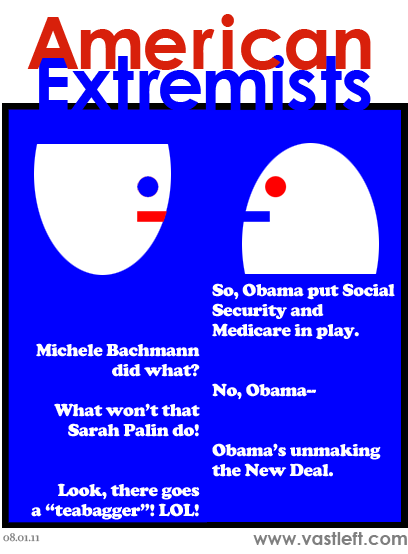 The second is a tweet by liberal Charles Davis: “Remember when Michele Bachmann killed all those innocent people in Afghanistan, Pakistan, Yemen, Iraq and Libya? Ugh. Hate her.” Such self-examination will almost certainly pass as we get closer to November 2012. If it doesn’t, Obama is in even bigger trouble than he looks, because it would mean that he’s moving from Dukakis into Carter territory.
But Galston’s piece is even more damning. Here he is dropping the hammer:
As many critics have pointed out, this man-made crisis was entirely avoidable. The Democrats could have raised the ceiling last December. They chose not to, handing a sword to their adversaries. Senate majority leader Harry Reid wanted to force the incoming Republicans to accept some responsibility for the increase. We’ve seen how that worked out. And if President Obama genuinely believed that the Republicans would cooperate because it was the right and responsible thing to do, then naïveté was the least of his mistakes. (A moment of introspection about his own 2006 vote against increasing the debt ceiling should have sufficed to disabuse him of that notion.)
2 comments
The Problem with Huntsman
August 1st, 2011
From John Heilemann’s great piece in New York Magazine:
1 commentA month later, when he visited New York on a fund-raising swing, I asked who his political heroes were. “Reagan was certainly part of that,” Huntsman said, though he paraphrased Dutch’s ringing anti-statism as a commitment to “making sure government never exceeds boundaries and never gets out of control from a cost standpoint.” He also mentioned Nixon: “I mean, here’s a guy who created the EPA.”
Tomorrow’s Op-Eds Today
July 28th, 2011
John Edwards Was a Contender?
June 6th, 2011
I don’t mean to make too much of Steve Kornacki’s Salon piece about how close John Edwards came to the presidency–I understand what he’s getting at and his macro point is valid. (When you look back through modern political history, it’s amazing/terrifying how many people get close to power and then later turn out to be crazy.)
But I think Kornacki has it slightly backward: The closest Edwards got the presidency was when he made it onto the Democratic ticket as John Kerry’s vp. I followed Edwards pretty closely during the two cycles in which he ran for president and it was awfully clear that he was a two-faced candidate. Sometimes he was very, very good with voters. Sometimes he was dreadful. If you believe that raw political skill matters in these things, then it’s hard to believe that Edwards was ever destined to win anything. (On his own, that is.)
I hate to keep harping on this, but if you want to measure the skill-set of a politician, it’s not that hard. A politician’s primary job is to get more votes than the other guy. So just look at their record in campaigns. Good politicians win more–many more–races than they lose. Bill Clinton, Harry Reid, Al D’Amato, and John McCain all have one thing in common: They won a lot of races.
John Edwards, on the other hand, was [not] good at winning elections. Not very good at all. Sure, he had the ability to self-fund, but over the course of his entire political career, he won two races: In 1998 he beat a 70-year-old first-term incumbent to win his Senate seat. And in 2004 he won the South Carolina primary. That’s it. Lifetime, that’s something like 2-45.
My point is, politicians who lose election after election after election do not tend to suddenly start winning elections and go on a tear. Despite what journalists and political professionals thought of John Edwards, the candidate, voters never liked him.
3 commentsKicker of the Day
May 19th, 2011
Michael Graham ends his column with a line that should get marked down and re-used, a lot:
“Barack Obama is the Nixon the left always wanted.”
You can sub a hyphen for the “is” in the bumper-sticker version.
0 commentsWho’s the Most Desperate GOP Candidate?
May 12th, 2011
Whoever employs this guy:
In exchange for anonymity, an official for another GOP prospect provided contact information for the ex-wife of the man Cheri Daniels married, in the years between her divorce and remarriage to Daniels.
I’ll give you three guesses.
6 commentsMark Levin’s Litmus Test
February 25th, 2011
While the rest of Republican America is swooning for Chris Christie, Mark Levin isn’t buying it. Levin seems not to consider Christie a viable presidential candidate, which is perfectly sensible, since Christie isn’t going to run. But Levin’s discounting of Christie doesn’t seem to be based on political horserace calculations. Here are the clips from Galley Friend A.W.:
January 14: “The new GOP presidential hope? Are you kidding?”
February 16: “[H]e refuses to address issues that expose his weaknesses to conservatives.”
February 17: “For all the loud bravado, on this hugely important [Obamacare] issue he’s a wimp. . . . It’s fiscally irresponsible for Christie to sit on his butt and do nothing. Is this what they mean by frank talk? Maybe his supporters inside the beltway can help us better understand while they’re touting him for president.”
It’s unclear if Levin’s appraisal of Christie as an “irresponsible wimp” is the result of Christie not coming onto his show or some deviationist thinking concerning the 2010 Delaware Senate race.
1 commentMore on the American Narcissus
November 16th, 2010
0 comments
American Narcissus–Updated
November 15th, 2010
Over at the Standard I’ve got a medium-sized piece on President Obama’s vanity. There’s nothing really new in–it’s mostly a compendium of stuff we’ve all seen for the last two years, but tied together and in one place. Mind you, it’s an incomplete list. And the catalogue keeps growing.
Mentioning the piece, Scott Johnson adds a few bits, my favorite being that Obama’s vanity “almost disposes of the speculation that Obama is a Muslim. The man can’t be a Muslim; he worships himself.” Scott also notes a line from Obama in India about the Mahatma, MLK, and, well, I don’t want to spoil it for you. But here’s Scott: “Obama gives us history in the form of an arc bending inevitably toward himself.”
The Belmont Club’s Richard Fernandez also adds a much more literate and philosophical riff, contrasting Obama’s sense of self with that of Churchill, who was never bashful about his own merits:
Both men saw themselves as agents of greatness. Where they differed was where they ascribed its source. That and the fact that Lincoln and Churchill have already achieved that mantle of greatness which Obama so confidently believes is his. In the case of Lincoln and Churchill their presentiments are confirmed by the fact that they fulfilled them. They have already walked the walk. And now we see the talk was true. In the president’s case his claims have not yet been confirmed by events. . . .
It may be that his presentiment will prove true, though perhaps he should have waited until those events actually took place before claiming the due. But that would have been for lesser men, for minds less certain of their powers. And the central point of Jonathan Last’s entire essay was that for Barack Obama, destiny shone so clearly before him that he could touch it and hold it in his hand. And therein lies the danger. For if fate can promise, it can also betray. The three witches in Shakespeare’s Macbeth knew that some things should only be reckoned in the end.
And the great Jennifer Rubin teases out some of the implications of Obama’s vanity-driven administration:
the colossal failure of his international endeavors, specifically his Muslim Outreach, is traceable to the faulty notion that one can construct a nation’s foreign policy based on the persona of its president. It sounds daft — why would the Israelis and Palestinian simply reach a deal because Obama has arrived on the scene? Why would the mullahs be enticed to curb their nuclear and hegemonic ambitions because he allegedly ”understands” the Muslim World? The Ego has made hash out of foreign policy because he believes, as the saying goes, that the world revolves around him. He can’t imagine that rivals, foes, and allies are immune to his charms.
Among the anecdotes I left out was a scene I witnessed at an Obama campaign rally before the Nevada caucus in 2008. Michelle Obama was introducing her husband to a crowded school cafetorium (?) and she said made a very concerted point of the following: “Barack is one of the smartest men we will see in our lifetime.”
Now look, many (most?) wives have idealized visions of their husbands. This is not a bad thing. On the contrary, it’s quite good. And perhaps even necessary for the survival of the species. But it’s one thing to think that your spouse is better looking, or more charming, or more intelligent than he really is. And it’s another to insist–to a room full of people–that he’s a Stephen Hawking-level genius. Even if we were to stipulate that Barack Obama is really, really, really smart–maybe the smartest guy ever in American politics (which, by the by, is almost certainly not true), you could walk into the cafeteria at MIT right now, swing a bat, and knock over three people who have 20 IQ points on him.
Exit question: The piece came out online Saturday morning. What’s the over-under on the “uppity” charge? Tuesday?
PS: I may update this thread through the day.
Update 7:02: A reader passes along this fantastic bit from a 2004 Ryan Lizza profile of Obama in the Atlantic:
4 commentsI couldn’t help noticing, when we sat down to talk in the dilapidated storefront that houses his Springfield campaign headquarters, that the blue-pen drawing he’d doodled on his newspaper during fundraising calls was a portrait of himself.
Primary Games
November 8th, 2010
I’ve got a piece at the Standard about some different cross-trends concerning Obama’s reelection. In it, I mention that there’s a possibility Obama could face a primary challenge, but it would come most probably from his left. Galley Friend P.G., however, makes the following observation:
Go check out last week’s NYT op-ed pages. Guess who has a really good op-ed: Evan Bayh. Guess what else he has: a $10M war chest that he refused to donate to dem candidates even as he was retiring from the Senate. $10M isn’t much in terms of presidential runs, but it’s enough to build an organization for Iowa.
I think it’s wrong to hypothesize about a primary challenge solely from the left. You can’t run on Obama’s left on domestic policy, and if you try to run to his left on the wars, he’ll just say that he tried to end the wars but was blocked by Republicans and the military (and he wouldn’t be lying). However, you can run against the war to Obama’s right, based on the cost of the war and its impact on the deficit.
Maybe there isn’t a difference in saying “We need to end the wars because our soldiers are dying, we’re occupying a foreign country, blah, blah, blah” and “we need to reduce the deficit, as part of my plan I’d like to end the wars because they cost too damn much”. I, however, think there is a huge difference in these two positions. I think one comes across as post-VietNam pacifist nonsense while the other seems fairly reasonable. And I suspect there is a huge portion of middle-class white Dems who would agree.
Wanna know what I secretly think: Evan Bayh, with a Republican Congress and split Senate, would make a helluva Prez. He’s like Clinton without all the Clinton baggage and Clinton attack machine. Kinda like a 2000 McCain, only a little more pro-union and a little less pro-life.
Galley Friend K.A. sees broader openings:
The conventional wisdom is that a primary challenger to Obama couldn’t get traction because of the black vote. But I seem to remember Hillary polling pretty respectably against Obama among blacks. That all disappeared once it was time to get to voting, of course. But primary challengers might be able to believe that they could peel off some significant black support. The point is that Russ Feingold, or Hillary, or a prevailed-upon Howard Dean would only have to think they could beat Obama in order to really shake up the 2012 race. And a wounded Obama will look vulnerable, causing ambitious Democrats to see an opportunity. A primary challenge isn’t unthinkable, and even talk of a primary challenge is itself enormously damaging. Especially if the economy is continuing to doing poorly.
And about that: Americans’ feelings about the economy tend to lag around six to twelve months behind the actual data about how well or badly the economy is doing. People were still feeling pretty happy when the recession first started; they will still feel like they’re hurting long after unemployment has gone back down to 5 or 6 percent. That means that if the economy doesn’t really get moving immediately, people are still going to be really unhappy with the president by the late summer of 2011 — when potential 2012 candidates will be making their am-I-serious-or-not decisions. Prime conditions for a primary challenge!
Howard Dean is the other guy I’ve been thinking could challenge Obama, and he’s even better poised than Feingold. A former DNC chair who led the party during its recent successes times, he’s well liked for being a straight talker; his primary-night howl has now long been forgotten, or at least forgiven; and he’s been very smart about putting a bit of distance between himself and President Obama on healthcare and a few other issues. But I now see that, just in the last few hours, Dean has reportedly said, through a spokesman, “He is absolutely, categorically not running in 2012.” Ah well. Always time to change your mind, Howie!
The other wild card in all of this is Bloomberg, who needs neither the time to build an organization nor any rational evidence that he could win a presidential election.
0 commentsCowabunga. Dude. And Palin. And Sex Cannon. (Updated Throughout the Day)
November 3rd, 2010
Initial thoughts on the election. First, the recriminations!
* Mark Levin: Thanks. It was only, like, 16 points. Not that anyone should be surprised–after all, Levin’s the one person in America who likes Stephen A. Smith. And besides, it’s probably all the fault of the RINO’s anyway. After all, Levin is “an extraordinary intellect.”
* How’s that Limbaugh Rule working out? Or has it been downgraded to a mere hypothesis?
* It would be nice for the GOP to have Senate seats in CA and CT. And eMeg seems like a very nice and capable woman. But on the other hand, it’s encouraging to see that money can’t always buy votes. Unless you’re Mitt Romney, that is. (I mean the “encouraging” part, not the “can’t by votes” part.)
* Virginia was a purple state 24 months ago. Last night the 4 of the state’s 6 incumbent Dems lost and a fifth is on life-support, leading by 500 votes with 99% reporting.
* Jon Runyan wins in NJ-3. It’ll be fun having him in Washington. Expect chop blocks.
* If Lisa Murkowski holds on, then Mitch McConnell deserves some credit for finessing the situation after her primary loss. Remember the reports that the leadership was going to strip her of committee assignments, etc. if she mounted a write-in campaign? Good thing the GOP thought better of it.
* You’ve got to respect what Harry Reid did, coming from behind and grinding out a +5 win as the third most unpopular politician in America. Even while his son was losing the governor’s race by 12 points. Sure, the GOP helped him out by nominating Angle, but even so. Professional politicians win elections. Reid is a pro.
* That said, I would have gladly traded a Reid win for a Feingold, just on general principle. I won’t miss Feingold’s votes, but I’ll miss his general presence in the Democratic party.
* Where will the final House number be? It’s +58 now and we’re still waiting on 11 races. I suspect the GOP will end somewhere near +65.
* Remember when Obama told nervous House Democrats that “Well, the big difference here and in ’94 was you’ve got me.” Turns out he was right!
* Data to be on the look-out for today:
* What was the won-loss record for Dems in districts carried by McCain?
* How close were the races at the margins? Did the Dems avert a much larger disaster by winning a bunch of races by a couple hundred votes, or did they have bad luck by losing a bunch of very tight contests?
* How did the Obamacare Dem dissenters do? Was staying away on that bill enough?
* What was the win/loss ratio on incumbents polling under 50 percent (but still ahead) at the end?
Update 10:30: This may be too deep a reading, but Sarah Palin emerges as somewhat of a loser from last night. A number of her candidates did well, and she can point to Nikki Haley in South Carolina and a number of other pick-ups in which she batted comfortably over .500. But her three most high-profile candidates–Joe Miller, Christine O’Donnell, and Sharon Angle–all got housed.
What’s more, those three candidates were each, in their own way, minor proxies for Palin as a political commodity. Miller tested free-base Tea Party-ism; O’Donnell tested the strength of anti-anti-Palinism sprung from deeply unfair treatment from the press and the left; and Angle tested the ability of a flawed candidate with high negatives to compete with a deeply unpopular liberal, Democratic incumbent on a relatively even playing field. You could read too much into this, but each of these losses undercuts, to some degree, the thesis that Palin could win a 2012 general election. (Mind you, I wouldn’t completely discount this thesis yet.)
But the thing which struck me as most problematic for Palin was a moment on Fox last night where, asked about O’Donnell’s loss, she said something to the effect of, Yeah, well the exit polling shows Castle would have lost, too, so why dontcha ask the lying MSM about that? (I paraphrase.)
This strikes me as not the kind of answer Palin should be giving. Her bread-and-butter is (or should be) authenticity. The correct response for O’Donnell supporters this morning goes somewhere along the lines of: “Yeah, it didn’t work out for us, but at the end of the day, the risk seemed worth the reward. If you’re going to make broad gains anyway, you might as well make some bold ideological bets. Some won’t pay out. And besides, did Republicans really need another guy in the Senate who’s been a professional politician since Calvin Coolidge graduated high school?”
That’s just about the only sensible response. Palin taking a Levin-like I-have-an-answer-for-everything is fine, except that that’s not who she’s supposed to be. She’s supposed to be a truth-teller, like a political Simon Cowell.
Update 12:25: Best lines so far:
* Rush Limbaugh was the big winner!
* Mark Levin says everything is great for conservatives. Because compromise is “irrational.” Sounds like he’s auditioning to be an Obama boogeyman.
Update 12:45: Meanest thing ever said about Jon Stewart:
Maybe it’s not fair to blame Jon Stewart for all this. He’s a comedian, after all. But he’s the left’s closest equivalent to Rush Limbaugh or Glenn Beck.
Fightin’ words.
Update 12:58: The Sex Cannon is BACK baby! Two tons of twisted steel and sex appeal, firing that ball in there deep, real deep, where it’s gotta be, ’cause he’s not a gunslinger, he’s a–GUH–WATCH THE BLINDSIDE!
(Where’s the Emo Eagles fan? We need him.)
Also, Tony Dungy and Rex Ryan intervene to help a troubled teen sort out some strange feelings he’s been having recently. Don’t miss this Very Special Episode of KSK.
Update 2:50: Dana Milbank writes, “At Rupert Murdoch’s cable network, the entity that birthed and nurtured the Tea Party movement, Election Day was the culmination of two years of hard work to bring down Barack Obama – and it was time for an on-air celebration of a job well done.”
While the thrust of what Milbank is getting at is true–Glenn Beck has played a large (if not irreplaceable) role in stoking the Tea Party movement, the entire Tea Party moment began on CNBC with non-politico Rick Santelli. Does no one remember?
8 comments