April 11th, 2011
I caught five minutes of PBS’s old warhorse Antiques Roadshow this weekend and saw something fantastic–a set of the original art used for Christmas cards put out by Cape Canaveral–before the town had formally found its identity as the Kennedy Space Center. You can see the full set here, but this will give you a flavor of the awesome:
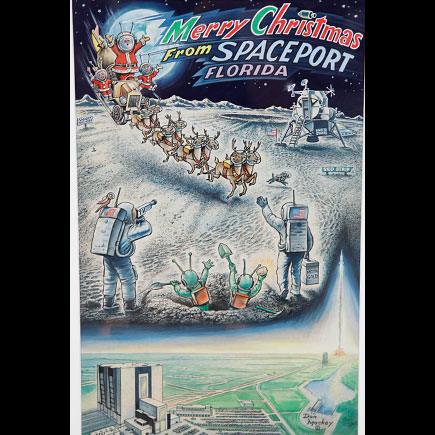
It’s pretty wonderful and I’d love to get a print. The only problem is that it’s not clear if the art is by “Donald Mackey,” as the Antiques Roadshow people say, or by this “Donald Mackay.”
5 comments
The Future of TV?
April 11th, 2011
Forced to choose one, I’m not sure if I’d rather have 3D or Ultra HD. Not that we’re going to get the choice. The Euros seem to be going after HUHD while the U.S. and Japan chase 3D.
How far along are we? Well, YouTube is now accepting uploads in 3D . . .
0 commentsMore on Kinsley, Gates
April 7th, 2011
Steve Sailer has a good angle on that post about Michael Kinsley’s quasi-defense of Bill Gates and MSOFT. I kept wondering what Kinsley’s angle was, though. Galley Reader X has an idea:
Do you think it’s weird that the words “Patty Stonesifer” don’t appear in Kinsley’s article? For a long time she was CEO of the Bill and Melinda Gates Foundation. Which was of course a massively successful PR campaign. I don’t know. Kinsley’s wife is neck deep in the Bill Gates image restoration business. Kinsley writes a Bill Gates image restoration piece. Seems like an important thing to disclose.
0 comments
There’s a mole. And it’s way. Down. Deep.
April 6th, 2011
Noah Shachtman has a truly fantastic piece on the 2001 anthrax mailings in the latest Wired. I can’t say enough about it. Just go print and enjoy. Amazing reporting; clear writing. A total triumph.
1 commentOdds and Ends
April 5th, 2011
A little housekeeping on unrelated items.
* Remember our question about betting on WrestleMania? Deadspin has the answers in a piece so thorough and well-reported that you’d be surprised to find it even in the sports section of a big-city daily. It’s WSJ levels of good.
* Michael Kinsley has a retroactive quasi-defense of Microsoft. He opens with Microsoft’s history of DC lobbying, painting them as charmingly naive because Bill Gates didn’t think he needed to lobby the government. He writes:
For many years before the lawsuit, Microsoft had virtually no Washington “presence.” It had a large office in the suburbs, mainly concerned with selling software to the government. Bill Gates resisted the notion that a software company needed to hire a lot of lobbyists and lawyers. He didn’t want anything special from the government, except the freedom to build and sell software. If the government would leave him alone, he would leave the government alone.
At first this was regarded (at least in Washington) as naive. Grown-up companies hire lobbyists. What’s this guy’s problem? Then it was regarded as foolish. This was not a game. There were big issues at stake. Next it came to be seen as arrogant: Who the hell does Microsoft think it is? Does it think it’s too good to do what every other company of its size in the world is doing?
Ultimately, there even was a feeling that, in refusing to play the Washington game, Microsoft was being downright unpatriotic. Look, buddy, there is an American way of doing things, and that American way includes hiring lobbyists, paying lawyers vast sums by the hour, throwing lavish parties for politicians, aides, journalists, and so on. So get with the program.
So that’s what Microsoft did. It moved its government affairs office out of distant Chevy Chase, Md., and into the downtown K Street corridor.
Who is it exactly who “had this feeling” that Microsoft was being “unpatriotic” by not playing the lobbying game? Kinsley was closer to the situation than most of us onlookers, but I don’t ever recall hearing anything even remotely like that complaint made, even once–let alone often enough to claim that it represented some form of the conventional wisdom. And Chevy Chase is “distant” from K Street? It might be six miles. It’s not like MSOFT was headquartered in Columbia, MD. Makes you wonder what angle Kinsley is playing this time–is he trying to hit a bank-shot knock against a past employer, or sucking up to a potential new one?
* David “Spengler” Goldman has an interesting piece about the GOP 2012 field. He opens with the following:
Never before in American politics have so few offered so little to so many. I refer to the prospective Republican candidates for next year’s presidential elections, not a single one of whom elicits a response that might be mistaken for enthusiasm from the voters, the pundits, or the party’s elder statesmen.
There are a couple of generic governor types like Tim Pawlenty of Minnesota or Mitch Daniels of Indiana, and a long list of has-beens and never was’s. But the Republicans despair of finding the man or woman who can define an alternative to a weak and waffling President Barack Obama.
I’m not sure this is quite right, either. The problem for Republicans–to the extent that it is a “problem,” which I kind of doubt–is that the candidates excite different parts of the base. Have you seen the reaction parts of the base have for Sarah Palin? There’s a segment of the Tea Party that goes nuts for Newt. It would not surprise me if Mike Huckabee was really blowing the skirts up on Christian cultural conservatives. And while Goldman dismisses Mitch Daniels as a “generic governor type,” among DC elites, people are swooning over him like he’s the second-coming of Scoop Jackson.
Now, none of these candidates has wide appeal, yet. But they each have appeal which seems pretty deep, considering that most of them haven’t even declared yet. What’s more, the eventual Republican nominee doesn’t have to worry about exciting the base, because Barack Hussein Obama will do that more effectively than any GOP candidate possibly could.
Finally, the extent to which a Republican will need to make a clear case in 2012 seems unclear. There are a handful of candidates who probably can’t unseat Obama no matter what. But assuming one of them doesn’t take the nomination, how much difference would it make for Candidate X to be running as opposed to Candidate Y if unemployment is 9 percent, gas costs $3.50, the housing sector is still dead, and America is still floundering abroad?
* Last, Galley Friend A.W. sends a link to this epic Susannah Breslin piece on the porn industry. How good is it? So good that you might walk away rethinking the welfare state:
4 commentsHere, I just give, give, give! And this is a fact!” he shouts, wild-eyed. “We are helping these girls! Anybody that comes into this business, for the most part, is a broken toy.” He leans towards me, earnestly attempting to make himself understood. “We’re giving them a place where they can make money, and get by, so they’re not standing on line in a welfare department. Thank God for people like me!” He bangs the desk.
Bernard Lewis
April 2nd, 2011
He’s still all sorts of awesome. This passage from a WSJ interview is particularly excellent:
As the Iranian revolution was beginning in the late 1970s, the name of Ayatollah Ruhollah Khomeini was starting to appear in the Western press. “I was at Princeton and I must confess I never heard of Khomeini. Who had? So I did what one normally does in this world of mine: I went to the university library and looked up Khomeini and, sure enough, it was there.”
‘It” was a short book called “Islamic Government”—now known as Khomeini’s Mein Kampf—available in Persian and Arabic. Mr. Lewis checked out both copies and began reading. “It became perfectly clear who he was and what his aims were. And that all of this talk at the time about [him] being a step forward and a move toward greater freedom was absolute nonsense,” recalls Mr. Lewis.
“I tried to bring this to the attention of people here. The New York Times wouldn’t touch it. They said ‘We don’t think this would interest our readers.’ But we got the Washington Post to publish an article quoting this. And they were immediately summoned by the CIA,” he says.
Today, of course, our top thinkers would just do a Google search on “Khomeini.” And if nothing came up on the first page or three, then consider him vetted!
0 commentsNow who’s being naive?
April 1st, 2011
Scott Johnson has a great catch of a tremendously disturbing detail from Bush’s memoir:
I was especially worried about [Putin’s] arrests of Russian businessmen and his crackdown on the free press. “Don’t lecture me about the free press,” he said. “Not after you fired that reporter.” It dawned on me what he was referring to. “Vladimir, are you talking about Dan Rather?” I asked. He said he was. I said, “I strongly suggest you not say that in public. The American people will think you don’t understand our system.”
Whoa.
2 commentsArianna Huffington and the NYT
April 1st, 2011
The most uncomfortable interview ever?
You’ve been saying recently that The Huffington Post is not a lefty publication?
Actually I’ve been saying that for three years. The tag line that we’ve used a lot is “Beyond left and right.”Three years ago was 2008. I looked at The Huffington Post a great deal during the election. It felt like the Internet version of Keith Olbermann’s show, and if that’s not lefty. . . .
Why don’t you be more specific? What were the messages that you considered lefty?It’s as if you’re trying to tell me that Smurfs aren’t blue.
I’m just telling you that it is very clear that we have progressive views, but to call everything we’re doing lefty — it misses the whole point that American policy needs to be redefined beyond left and right. It’s a completely obsolete view of politics.Still, I’m amazed you’re trying to tell me that The Huffington Post wasn’t started as a lefty blog?
I’m not trying to tell you anything. I’m telling you things. I’m not trying, O.K.?
0 comments